This content has been translated from the original text.
The “Regulation Amending the Regulation on Commercial Advertising and Unfair Commercial Practices”, published in Official Gazette No. 33297 of 1 July 2026 (OG: 01.07.2026, No. 33297), has made comprehensive amendments to the Regulation on Commercial Advertising and Unfair Commercial Practices published in Official Gazette No. 29232 of 10 January 2015. The Amending Regulation entered into force on 1 August 2026. The regulation has significant consequences, particularly for e-commerce and digital marketing, ranging from discount sale advertisements to environmental claims, from the use of artificial intelligence to social media influencers, and from targeted advertising to consumer reviews. In this article, the amendments are addressed article by article, together with their effects in practice.
The “Regulation Amending the Regulation on Commercial Advertising and Unfair Commercial Practices”, published in Official Gazette No. 33297 of 1 July 2026 (OG: 01.07.2026, No. 33297), has made comprehensive amendments to the Regulation on Commercial Advertising and Unfair Commercial Practices published in Official Gazette No. 29232 of 10 January 2015. The Amending Regulation entered into force on 1 August 2026. The regulation has significant consequences, particularly for e-commerce and digital marketing, ranging from discount sale advertisements to environmental claims, from the use of artificial intelligence to social media influencers, and from targeted advertising to consumer reviews. In this article, the amendments are addressed article by article, together with their effects in practice.
1. New Definitions (Article 1 of the Amending Regulation)
The definitions of “environmental claim”, “social media”, “social media influencer” and “consumer reviews” have been added to the first paragraph of Article 4 of the Regulation as subparagraphs (r), (s), (ş) and (t). In particular, a social media influencer is defined as a natural or legal person who engages in marketing communication by sharing content on social media, directly or indirectly, to promote a good or service on their own behalf or on behalf of an advertiser, and who converts this communication into a benefit. Thus, not only posts made on behalf of an advertiser but also promotional activities that the influencer carries out on their own behalf and converts into a benefit fall within the scope of the definition.
2. Restriction on the Misleading Use of Academic Titles (Article 2)
The phrase “academic titles,” has been added, after the phrase “awards,”, to subparagraph (g) of the fifth paragraph of Article 7 of the Regulation. The paragraph in question provides that advertisements may not contain statements or images that may directly or indirectly mislead the consumer on any matter; subparagraph (g) lists, by way of example, official recognition or approval, medals, awards, diplomas and similar documents. With the amendment, academic titles have also been included in this list; thus the misleading use of academic titles has become a matter to be assessed as directly deceptive advertising. The provision is particularly important for health and beauty advertisements that are run on the perception of expertise or scientific authority.
3. Comparison in Food Supplement Advertisements and a New Prohibition (Articles 3 and 11)
The phrase “and food supplements” has been added after the word “Food” in the third paragraph of Article 8 of the Regulation, and the last sentence of the same paragraph, which absolutely prohibited comparative advertising of food supplements, has been repealed. Accordingly, matters falling within the scope of a health claim cannot be made the subject of comparison in advertisements for foods and food supplements, while the use of matters falling within the scope of a nutrition claim as an element of comparison is governed by the provisions of the relevant special legislation. This amendment allows comparative advertising of food supplements as well, in respect of matters outside the scope of a health claim, provided that the general conditions of the Regulation on comparative advertising are complied with.
In parallel with this, the tenth paragraph added to Article 27 expressly prohibits advertising food supplements in a way that gives the impression that they replace foods consumed as part of a normal diet.
4. The “10-Day Rule” and Channel-Based Pricing in Discount Sale Advertisements (Article 4)
The third paragraph of Article 14 of the Regulation has been replaced in its entirety. Under the new provision, when determining the pre-discount price, in advertisements relating to the sale of goods the lowest price applied within the ten days preceding the start date of the discount is taken as the basis. In advertisements relating to perishable goods such as fruit and vegetables and to services, the price immediately preceding the discounted price will continue to be taken as the basis. In this respect, the ten-day reference period applies only to advertisements relating to the sale of goods; service advertisements fall outside the scope of this period. Because the paragraph has been replaced in its entirety, the last sentence of the former text, which stated that the burden of proof lay with the advertiser, is also absent from the new paragraph; the general obligation concerning proof of the claims in advertisements, however, continues to apply under the relevant provisions of the Regulation and within the framework of Law No. 6502.
Under the fifth paragraph added to the same article, where a good or service is offered for sale through different sales channels, the pre-discount price is determined by taking into account only the price in the channel in which the discount is made; a price applied in one sales channel cannot be used as the basis for a discounted sale in other channels. Under the sixth paragraph added, the provisions on discounted sales apply to advertisements relating to loyalty programmes where the programme is easily accessible or usable by consumers. With the seventh paragraph added, conditional sale advertisements, in which a discount or other benefit is made subject to a condition such as the purchase of a certain quantity, number, amount or type of goods or services or the performance of a certain transaction, are also made subject to the provisions on discounted sale advertisements, except for the provisions on stating the quantity of goods or services.
5. Proof and Transparency in Environmental Claims (Combating “Greenwashing”) (Article 5)
The phrase “and misleading” has been added after the phrase “deceptive to consumers” in the second paragraph of Article 17 of the Regulation; thus it is provided that environmental marks, symbols and approvals may not be used in a manner that is deceptive and misleading to consumers. The third paragraph of the same article has been replaced in its entirety. Under the new third paragraph, in advertisements containing environmental claims, the certificates and approvals stated must be proven by documents obtained from competent institutions and organisations, from the relevant departments of universities, or from accredited or independent research, testing and evaluation bodies.
An aspect of this amendment that is frequently overlooked is that the former text of the third paragraph has been repealed. The repealed provision stipulated that, on the environmental impact in advertisements, only scientific findings and technical demonstrations based on scientific studies accepted by academic institutions could be used. The new regulation does not contain this specific limitation on sources; instead, it introduces a document-based regime of proof for certificates and approvals. However, the general burden of proof under Article 9 of the Regulation continues unchanged: advertisers are obliged to prove the accuracy of the claims in their commercial advertisements, and verifiable facts in advertisements must be substantiated with information and documents of scientific validity. The amendment has therefore not removed the requirement that environmental claims be scientifically verifiable; it has merely, by removing the specific limitation on sources in the former third paragraph of Article 17, established a new documentation regime for certificates and approvals.
Under the fifth paragraph added to the same article, general environmental concepts and expressions such as “eco-friendly” and “nature-friendly” cannot be used without explanation or in a way that causes uncertainty among consumers as to the environmental effects of the good or service or of its production processes. With the sixth paragraph added, it is made mandatory that the advertisement clearly state which section, part or process in the life cycle of the good or service the environmental claim relates to, and that explanatory information on the methods of measuring or assessing environmental effects be provided in the area in which the advertisement is published, or on the website or pop-up screen to which consumers are directed by means of a link or warning sign.
Important note: The regulation does not make it mandatory to obtain certification from an independent body for every environmental claim. The certification obligation is provided for the certificates and approvals specified in the Regulation, and the accepted sources of proof are determined so as to cover more than one type of institution and organisation.
6. Transparency Regarding Certain Uses of Artificial Intelligence and Software in Advertisements, and the Prohibition on Digital Replicas (Articles 6 and 11)
Under the eighth paragraph added to Article 18 of the Regulation, where artificial intelligence or other software is used in advertisements in a way that significantly affects consumers’ economic behaviour regarding a good or service, or where digital characters indistinguishable from humans created using artificial intelligence technologies are featured, this must be stated in a clear, understandable and distinguishable manner.
In addition, the twelfth paragraph added to Article 27 prohibits the use, in advertisements, of a digital replica of a real person created using artificial intelligence technologies where it falsely gives the impression that the person has personally experienced or used a good or service or where it makes a recommendation.
7. Advertisements Made Through Social Media Influencers: New Article 23/A (Article 7)
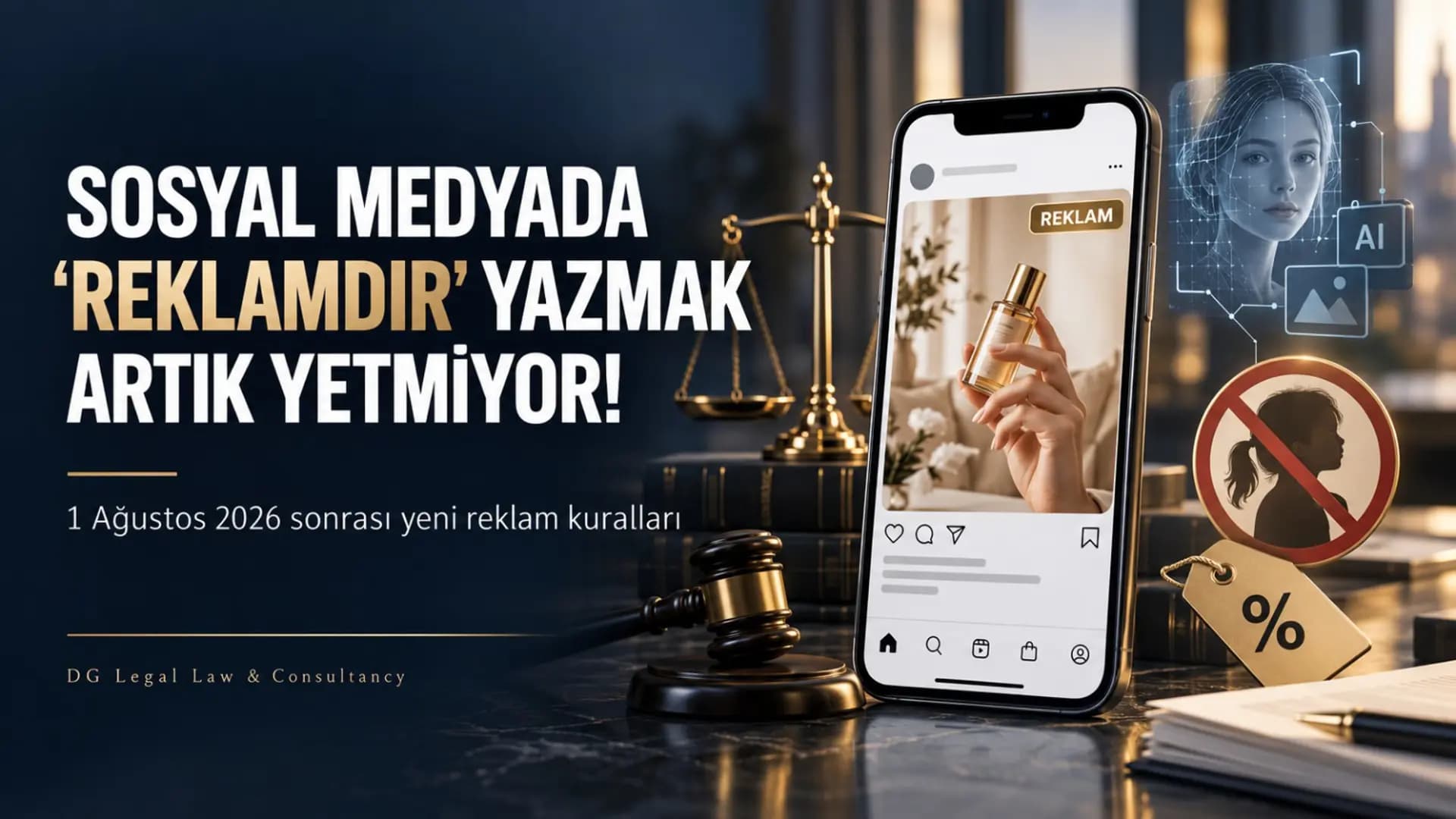
The new Article 23/A added to the Regulation makes it mandatory that advertisements made through social media influencers be clear, understandable and distinguishable. In cases such as directing to the advertiser or to the advertiser’s good/service; obtaining a benefit from the advertiser such as financial gain or free or discounted goods or services; sharing content for a prize draw, contest or campaign organised to promote the advertiser’s good or service; or making a post in return for a benefit obtained by taking part in an event organised by the advertiser, it must be clearly stated that the content is an advertisement. The cases listed are not a closed list; by using the phrase “in cases such as”, the provision adopts an illustrative enumeration.
In these advertisements, one of the expressions “Advertisement” or “Promotion” must be included. Together with these expressions, the content must include the advertiser’s name or trade name or one of the similar statements exemplified in the Regulation, such as “provided by [advertiser]” or “thanks to [advertiser] for sending me the products”.
The advertising disclosure must be distinguishable from the colour and background of the post, easily readable, and noticeable at first sight without the consumer needing to scroll the screen. If there are other labels or statements, the advertising disclosure must be shown before them and in a clearly distinguishable manner, and must not overlap with any text or icon, taking the platform’s interface into account. For content spread over more than one post or transferred to different post formats, the disclosure must appear in each post. For audio-only posts, the statement “contains advertising/promotion about [advertiser].” must be included at the beginning of the broadcast and before the advertisement to be broadcast; the disclosure here must also include the advertiser’s name.
8. The Expression “Interest or Profit Share” in Financial Service Advertisements (Article 8)
The phrases “and profit share” in the first and second paragraphs of Article 25 of the Regulation have been changed to “or profit share”. The amendment is not limited to the first paragraph, which governs the accurate statement of interest and profit share rates; it also covers the second paragraph, which provides that, in advertisements for credit services, the monthly and annual percentage value of the total cost of the credit to the consumer must be stated in the main promise of the advertisement. Thus, it has been made clear that cases in which an advertisement, depending on its nature, contains only an interest rate or only a profit share rate also fall within the scope of both paragraphs. The obligation to state these rates accurately and to include in the advertisement the conditions that will affect the total amount to be obtained at maturity continues.
9. Targeted Advertising and the Protection of Children: New Article 25/A (Article 9)
Under the new Article 25/A, the presentation by sellers and providers, and by intermediary service providers that mediate the conclusion of distance contracts on their behalf, of advertising content tailored to specific persons or groups by analysing consumers’ online behaviour, past preference records, location information, demographic data or similar personal data is regarded as targeted advertising.
For the purposes of the Regulation, targeted advertising may be carried out provided that the consumer is given direct and easily accessible information on the criteria used to show the advertisement to the consumer concerned and on how these criteria can be changed. However, this provision does not on its own make a personal data processing activity lawful; the legal basis, information and other obligations under the relevant data protection legislation, in particular Personal Data Protection Law No. 6698, must be assessed separately.
Targeted advertising using profiling methods based on personal data is prohibited where it is known, or can reasonably be expected to be known, that the consumer is a child.
10. Repeal of Article 26 on Goods and Services Subject to Special Regulation (Article 10)
Article 26 of the Regulation, titled “Goods or services subject to special regulation on advertising”, has been repealed. The repealed provision contained a general reference stating that advertisements for medicines, human medicinal products, medical devices, health services, foods, food supplements, cosmetic and cleaning products, biocidal products, tobacco products and alcoholic beverages must also comply with the advertising and promotion provisions of the relevant special legislation.
The repeal of Article 26 does not mean that the special legislation relating to these products and services has been repealed or will no longer apply. For the relevant product and service groups, the restrictions on advertising and promotion in their own special laws, regulations and other instruments continue to apply separately. With the amendment, the general reference provision within the Regulation has been removed, while in certain areas direct prohibitions have been added to Article 27.
11. Illegal Games of Chance, Human Medicinal Products and Unfair Prize Practices (Article 11)
With the amendment made to Article 27 of the Regulation, the existing advertising ban on illegal betting and gambling games, as well as on fortune-teller, medium, astrologer and similar services, has been extended so as to expressly cover “illegal games of chance” as well.
Under the provisions added to the same article, human medicinal products, electronic cigarettes, tobacco products and alcoholic beverages cannot be advertised. In addition, in advertisements for goods or services aimed at consumers, it is prohibited to include information on prizes that are not based on objective criteria announced in advance and that are given in return for a benefit. The prohibitions relating to food supplements and to digital replicas of real persons created with artificial intelligence are also among the new paragraphs added to Article 27.
12. Verification, Publication and Transparency Rules for Consumer Reviews (Article 12)
Article 28/B of the Regulation has been completely redrafted. If sellers and providers in the online environment, or intermediary service providers that mediate the conclusion of distance contracts on their behalf, enable consumers to submit reviews, reviews are permitted to be made only by persons who have purchased the relevant good or service. Consumer reviews obtained from media in which verification of the purchasing process is not possible cannot be published.
The principles and rules on the publication of reviews must be displayed in the area in which the reviews are published or on the pop-up screen to which the consumer is directed by a link or warning sign. These rules cannot be determined in such a way as to prevent reviews of the good or service or of the related ancillary contracts or to limit reviews to certain topics only. If separate reviews are published under different headings such as the good/service, delivery, or the seller or provider, all reviews must be presented in the same area in a clear, understandable, distinguishable and easily accessible manner.
Reviews must, after the necessary checks have been carried out, be published for at least one year, without distinguishing between positive and negative reviews, without any steering, and sorted according to an objective criterion such as date, review score or seller/provider. The reasons relating to reviews that are not permitted to be published must be notified immediately to the consumer who submitted the review. Reviews containing health claims in breach of the relevant legislation cannot be published.
Consumer reviews published in one medium may be published in other media only in a way that reflects the general character of the reviews in that medium in terms of content and rating. Reviews whose purchasing process has not been verified cannot be used in advertisements. If the consumer or the seller/provider notifies that the consumer’s grievance has been remedied, this is published without delay, after the necessary verification, in the same place as the initial review. It is also expressly prohibited to submit false reviews, or to enter into agreements with natural or legal persons to use statements endorsing a product/service, or to purchase services to that end, in order to increase the sales of a good or service.
13. 48-Hour Opportunity to Explain/Respond on Consumer Complaint Platforms (Article 13)
In subparagraph (a) of the first paragraph of Article 28/C of the Regulation, the phrase “at least seventy-two hours” has been changed to “forty-eight hours”, and the sentence “If no response is given within the period granted, the review is published directly.” has been added to the same subparagraph. The provision concerns complaint platforms whose main field of activity is to enable consumer complaints to be published online. The period that these platforms must grant, before a review is published, so that the seller or provider about whom the review has been made can exercise the right to give an explanation or respond is forty-eight hours.
A noteworthy aspect of the amendment is that the period has not merely been shortened: the phrase “at least” in the former text has also been removed. Since the new provision literally lays down a fixed period of forty-eight hours, it would be appropriate for platforms to design their publication processes on the basis of this period. In addition, under subparagraph (b) of the first paragraph of Article 28/C, reviews are not published before this period has expired or if it is understood that they do not reflect the truth. This secures the actual availability of the opportunity to explain and respond granted to the seller or provider.
Important distinction: This provision does not impose on the seller or provider an “obligation to respond within 48 hours”. The legal obligation concerns the relevant complaint platform granting a forty-eight-hour opportunity to explain/respond before publishing the review. For the seller or provider, this period is a period for exercising a right; if no response is given within the period, the review is published directly.
14. Amendment to the List of Examples of Unfair Commercial Practices (Article 14)
Item 13 in the section “A - Deceptive Commercial Practices” of the list “Example Practices Considered Unfair Commercial Practices” annexed to the Regulation, namely “Making a health claim about a good or service in breach of the relevant legislation.”, has been repealed.
This repeal does not mean that health claims in breach of the legislation have been liberalised. The provisions of the special legislation on health claims and the other relevant provisions of the Regulation continue to apply; for example, Article 28/B expressly provides that consumer reviews containing health claims in breach of the relevant legislation cannot be published.
15. Entry into Force and Execution
Pursuant to Article 15 of the Amending Regulation, the provisions entered into force on 1 August 2026. Under Article 16 of the Amending Regulation, its provisions are executed by the Minister of Trade. Accordingly, with regard to these provisions we are no longer speaking of a transitional period but of compliance obligations that are in force.
16. Supervision and Risk of Sanctions
Commercial advertisements and unfair commercial practices are subject to the supervision of the Advertisement Board under Articles 61, 62 and 63 of Law No. 6502 on Consumer Protection and the Regulation. It must be borne in mind that there are two separate sanction regimes under Article 77 of the Law. A breach of the obligations relating to advertising is subject to the twelfth paragraph of Article 77; this paragraph provides for the sanctions of cessation, correction by the same method, suspension as a precautionary measure for up to three months where deemed necessary, and an administrative fine, and graduates the administrative fine according to the medium in which the advertisement is published. Breaches relating to unfair commercial practices fall under the thirteenth paragraph; however, if it is determined that the breach was committed by means of advertising, the twelfth paragraph still applies. It is therefore incorrect to speak of a single common penalty range for both types of violation.
Taking into account the amounts updated by the revaluation rate, the administrative fines to be applied in 2026 under the twelfth paragraph of Article 77 range from TL 99,339 to TL 39,916,524, depending on the type of medium. This range is not a fixed penalty applied automatically to every violation, but is determined according to the medium in which the advertisement is published and the lower and upper limits provided for in the Law. In particular, for violations committed by a television channel broadcasting via satellite or via the internet, the administrative fine that may be applied for 2026 is between TL 1,083,706 and TL 10,837,065. In determining the administrative fine to be applied between the lower and upper limits, the Advertisement Board takes into account matters such as the wrongfulness of the violation, the magnitude of the benefit obtained or the damage caused by the violation, and the fault and economic situation of the person committing the violation.
In respect of e-commerce and digital marketing, however, the sharpest instrument in practice is often not the fine. Where the violation is committed on the internet, the Advertisement Board may decide to give notice, through means by which electronic communication can be established on the basis of information obtained from sources such as the means of communication, domain name and IP address on the relevant web page, for the content to be removed, and, if the content is not removed within twenty-four hours despite this notice, to block access. Only where notice cannot be given to the addressee may a decision to block access be made directly. A decision to block access is, as a rule, limited to the content in which the violation occurred; where it is technically impossible to block access to the content relating to the violation, or where the violation cannot be prevented by content-based blocking, a decision to block access to the entire website may be issued. The decision is sent to the Access Providers Association for implementation.
Assessment and Effects in Practice
The amendment package requires direct compliance, in particular from e-commerce platforms, marketplaces, brands, advertising agencies, social media influencers and businesses that process personal data in digital advertising processes. In discount sale campaigns, it is important to keep accurate records of the lowest price in the last ten days and of the price history by sales channel, and to assess loyalty and conditional sale campaigns under the new provisions.
In influencer marketing, cooperation agreements and content approval processes should be reviewed so as to secure compliance with the rules in Article 23/A on advertising disclosure, visibility, positioning and repetition in each post. In AI-assisted advertising processes, the content in which the transparency obligation arises should be assessed in advance. The use of digital replicas of real persons created with artificial intelligence in a way that creates the impression of experience or recommendation should be avoided.
In targeted advertising, mechanisms for providing direct and easily accessible information on the criteria for displaying advertisements and on changing these criteria should be established, and profiling-based targeted advertising practices concerning children should be stopped. These processes must be addressed together with Law No. 6698 and the relevant data protection legislation.
Consumer comment and review systems should be brought into line with the new requirements on purchase verification, objective sorting, a publication period of at least one year, notification to consumers of comments that are not published, and the use of comments in different media. Complaint platforms, for their part, should grant sellers or providers a forty-eight-hour opportunity to respond/explain before a review is published.
Businesses that use environmental claims should review the scope and explanations of general environmental statements in their advertising texts and ensure that certificates and approvals can be proven by documents of the kind listed in the Regulation. In financial services, food supplements, human medicinal products and other sectors subject to special regulation, the amendments to the Regulation should be assessed together with the relevant special legislation.
Conclusion
The amendments that entered into force on 1 August 2026 have introduced new obligations in commercial advertising and digital marketing practices, based on a higher level of transparency, verifiability and consumer protection. In particular with regard to discount sales, environmental claims, the use of artificial intelligence, social media influencers, targeted advertising and consumer reviews, it is important that businesses review their existing advertising and marketing processes in light of the new rules.
Compliance with the new regulations is important not only for reducing the risk of administrative sanctions but also for ensuring that advertising processes are carried out lawfully, transparently and in a way that can be audited. For this reason, businesses engaged in e-commerce, marketplace and digital advertising activities in particular need to assess their relevant processes together with the Regulation, Law No. 6502 and, where applicable, the provisions of sector-specific special legislation.