This content has been translated from the original text.
Criminal records are important documents showing the sanctions a person has previously faced under criminal law. Appearing in a wide range of contexts, from job applications to visa procedures, these records can often be difficult to understand because of technical terms and abbreviations. In our new blog post, we explain how to read criminal records, how they differ from archive records, and how entries are erased.
A criminal record is the official record in which information on a person's final criminal convictions is kept by the State. It plays a decisive role in areas such as entry into public service, firearms licence applications, eligibility for public tenders and visa procedures. However, the criminal record archive entry is just as important as the criminal record itself. The archive entry contains records that have been erased from the criminal record but are retained so that they can be provided to certain institutions. Accordingly, even where a person's criminal record appears clean, information about the past may still be held in the archive.
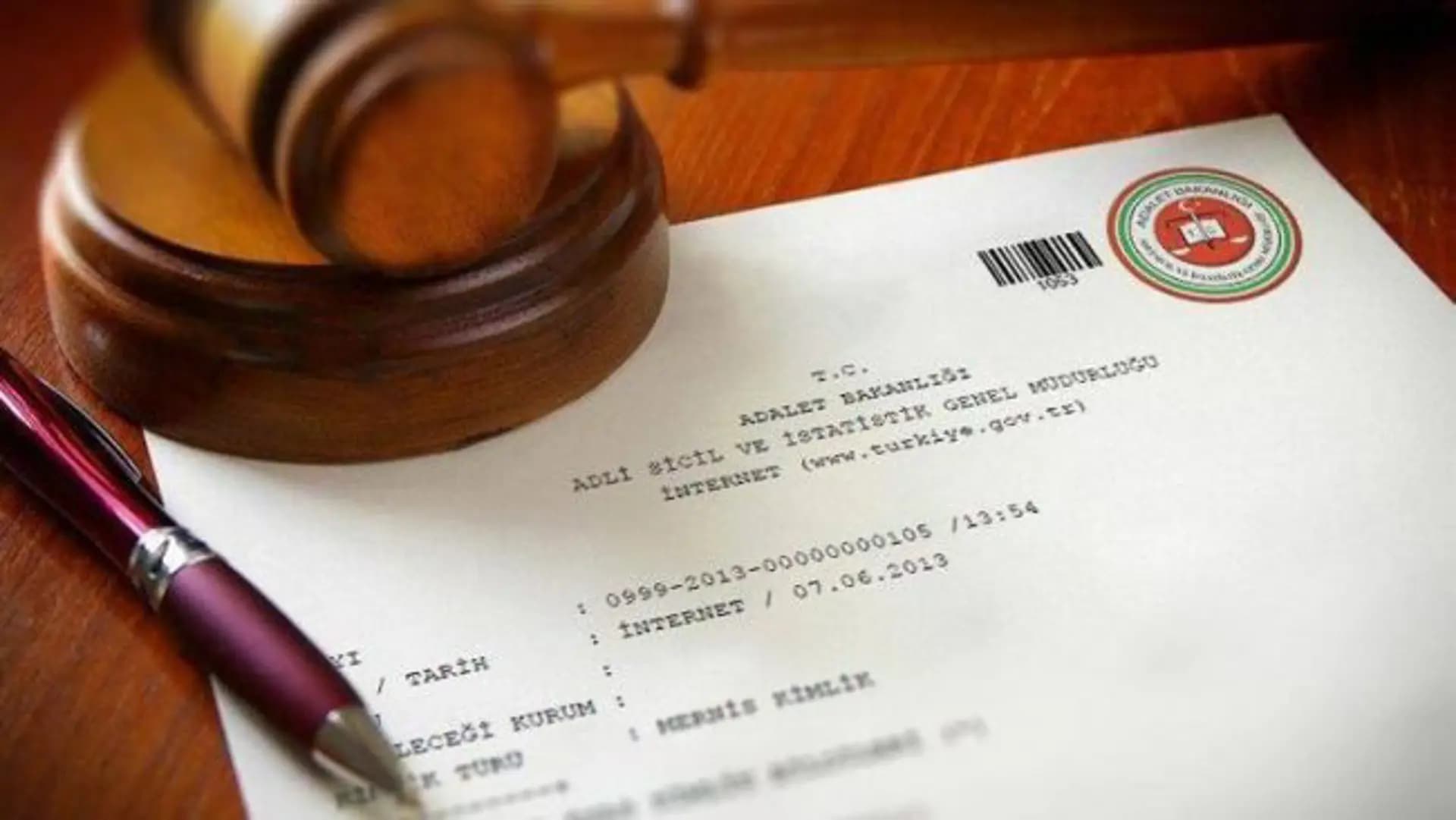
The Criminal Record (Adli Sicil Kaydı) contains a person's criminal convictions that are currently valid and have not been erased within the period prescribed by law. This record appears in the “Criminal Record” document obtained through e-Devlet. By contrast, the Criminal Record Archive Entry (Adli Sicil Arşiv Kaydı) shows records that have been removed from the criminal record once certain conditions have been met following the execution of the sentence, but which have not been eliminated entirely. Archive records are not shared with third parties other than public institutions. In other words, archive records do not appear in a criminal record that an employer requests through e-Devlet. However, individuals can also obtain their own Criminal Record Archive entries through e-Devlet. To do so, the “OFFICIAL” (RESMİ) option must be selected as the institution type on the “Criminal Record Query” screen.
Criminal records are drawn up using technical abbreviations and codes specific to court judgments. Understanding these abbreviations correctly is critical for interpreting the legal consequences of a record accurately. Lines beginning with the letter “C” denote final criminal conviction judgments; those beginning with “T” denote ancillary judgment slips (tali karar fişleri); and those beginning with “Y” denote execution slips (yerine getirme fişleri) relating to the enforcement of sentences. For example, “1C” indicates the first criminal slip, “2T” the second ancillary judgment, and “1Y” the first execution slip. The notation “ŞT.” denotes a decision on conditional release; the letter “B” denotes acquittal; and the letter “D” denotes a decision of discontinuance. Expressions such as CK:456/2,457/1 refer to the articles of the Turkish Penal Code (TPC) that were applied, while the abbreviation “H.” means imprisonment and “AP.” means judicial fine. “BTH” denotes release by right (bihakkın tahliye), that is, release after the sentence has been served in full. Long numeric strings beginning with “A00...” are the notification numbers registered in the UYAP system.
Other technical information in the records includes the name of the court that issued the judgment (for example, “Şişli 9th Criminal Court of First Instance”), the date of the judgment, the date of the offence, and the merits (esas) and decision numbers of the case. A reference to CMK 231 indicates that the judgment is a deferral of the announcement of the verdict (HAGB). “PDY” denotes sanctions converted into a monetary payment, while “ER” indicates that the sentence has been suspended. “E/K” shows the merits and decision numbers of the case file.
When these data are assessed as a whole, a criminal record is more than a mere record of prior convictions; it reflects the individual's entire relationship with the criminal justice system. For this reason, once a criminal record or archive entry has been obtained, its content should not be assessed merely as to whether anything is recorded or not, but should be analysed, together with its technical content, by legal professionals. A record that is misinterpreted may both harm personal rights and give rise to legal consequences.
Within this framework, the correct reading and interpretation of criminal records is of great importance not only for the protection of personal rights but also for transparency and legal certainty in public procedures.