This content has been translated from the original text.
The first and most decisive decision facing investors planning to operate in Dubai is whether the company will be established under a mainland (onshore) or a freezone structure. Until now, the main factor shaping this choice was the ownership structure; however, with the regulations the United Arab Emirates has introduced in recent years, 100% FOREIGN OWNERSHIP has become possible in both structures for most activities. This development has largely removed the ownership factor from the picture of choice; it has shifted the factors that determine the decision to commercial reality, that is, where income will be earned, the subject of the activity, the tax regime and operating cost.
The first and most decisive decision facing investors planning to operate in Dubai is whether the company will be established under a mainland (onshore) or a freezone structure. Until now, the main factor shaping this choice was the ownership structure; however, with the regulations the United Arab Emirates has introduced in recent years, 100% FOREIGN OWNERSHIP has become possible in both structures for most activities. This development has largely removed the ownership factor from the picture of choice; it has shifted the factors that determine the decision to commercial reality, that is, where income will be earned, the subject of the activity, the tax regime and operating cost.
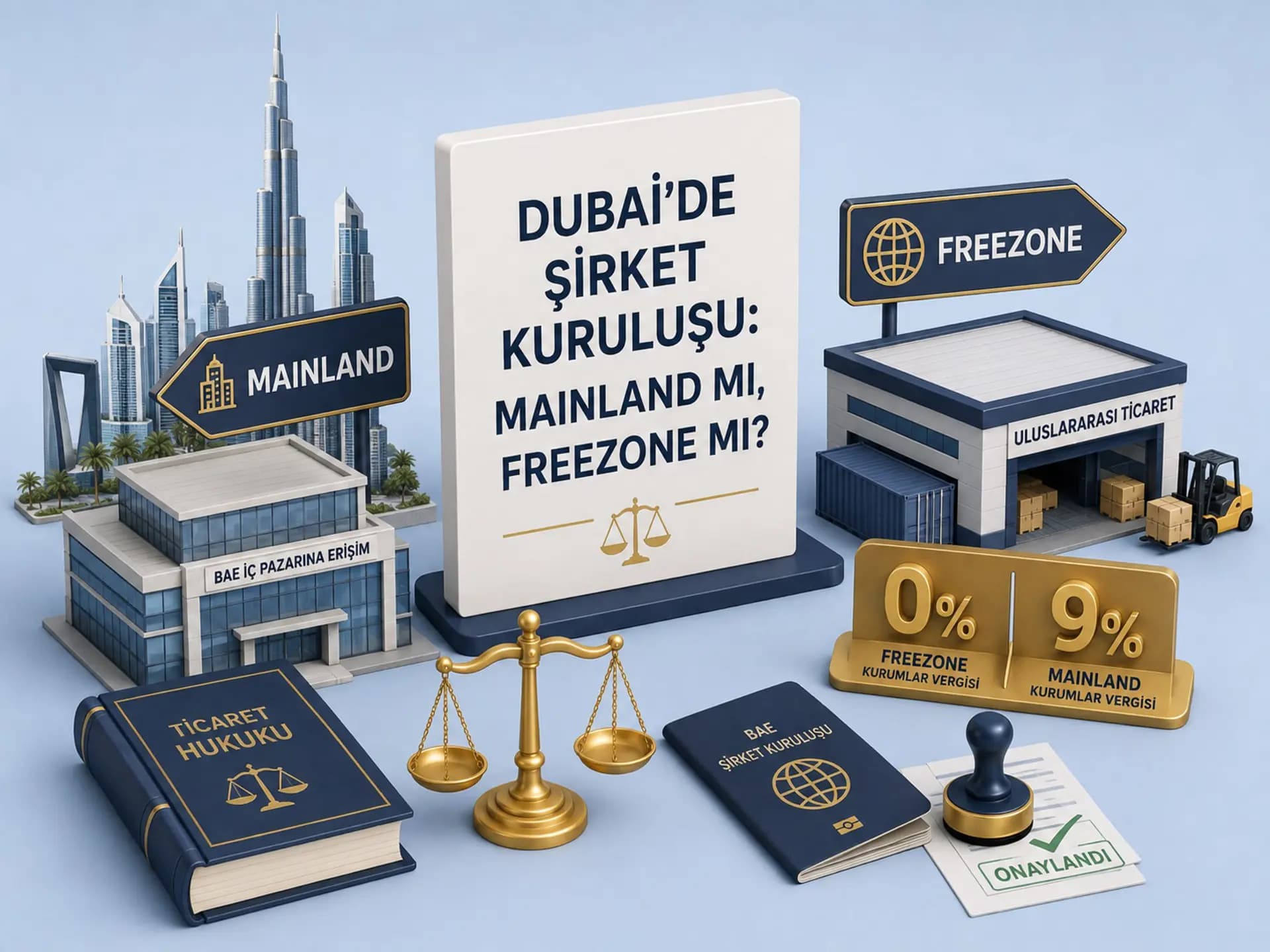
The first criterion at the heart of the choice is the target market and customer base. A mainland company licensed by the Dubai Department of Economy and Tourism (DET) may trade anywhere in the United Arab Emirates without being restricted to any local customer, may make retail sales and may take part in public tenders. A freezone company, by contrast, is as a rule structured to operate within its own zone or in the international market; in order to sell directly to the local UAE market it must use a distributor or local agent. Although the dual licence arrangements that some freezone authorities have developed with DET partly relax this limit, the rule remains that the freezone structure restricts direct access to the mainland market.
The second determining factor is the subject of the activity itself. While some activities, such as retail trade, construction, healthcare services or real estate brokerage, can in practice be carried out in any meaningful way only with a mainland licence, some sectors are specific to certain freezones: the principal examples are Dubai Media City for media and publishing, the Dubai International Financial Centre (DIFC) for financial services, and DMCC or VARA regulation for crypto assets and blockchain. For this reason, for many investors the choice is largely predetermined by the subject of the activity itself.
The third criterion is the corporate tax regime. Mainland companies are subject to the standard 9% corporate tax on profits above AED 375,000. Freezone companies, for their part, may benefit from the 0% tax advantage as long as they satisfy the status of “Qualifying Free Zone Person” (Qualifying Free Zone Person – QFZP). However, this status is not granted automatically; conditions must be continuously met, such as maintaining a genuine physical presence in the UAE (a real office, real staff, the core activity actually being carried out in the UAE), deriving income from qualifying activities listed in the law, and not deriving income from the mainland. If these conditions are not met, the freezone company too is subject to the standard 9% rate; for this reason, the assumption “I set up in a freezone, so I am automatically tax-free” is a point that frequently misleads investors.
The fourth factor is operating cost and physical office requirements. While an Ejari-registered physical commercial office is mandatory for mainland companies, in freezone structures incorporation can be completed at lower cost and more quickly with flexi-desk or virtual office options. By contrast, whereas mainland companies are scalable in terms of visa quota, the number of visas in freezone companies is generally limited depending on the size of the allocated office space.
As a result of weighing these four factors together, a strategy that is becoming increasingly common among investors as of 2026 is the hybrid approach: starting with a low-cost freezone incorporation and then, when the need to enter the local market arises, moving to the mainland or turning to a dual-licence structure. This strategy keeps risk low, particularly for start-up ventures, digital businesses and consultancy firms, while providing flexibility in the growth phase.
In conclusion, choosing the right structure in Dubai is no longer merely a comparison of a single advantage; it is a multi-dimensional analysis in which where the business will earn its income, which activity will be carried out, the targeted tax position and operational scale must be assessed together. At DG Legal, with our Istanbul, Ankara and Dubai offices, we support our investors in structuring this analysis in line with their concrete commercial objectives and in managing the company formation process end to end with the right choice of jurisdiction.