This content has been translated from the original text.
The international memorandum of understanding said to have been signed in the digital environment without a wet-ink signature gives rise to significant debates regarding the authority of states to represent, the validity of the electronic signature, the moment of entry into force, and the effect on international law of a breach of domestic law rules. In this article, topics such as the legal validity of digitally signed international agreements within the framework of the Vienna Convention on the Law of Treaties, the problem of authority to represent, the possibilities of error and fraud, the subsequent approval mechanism and digital document security are addressed.
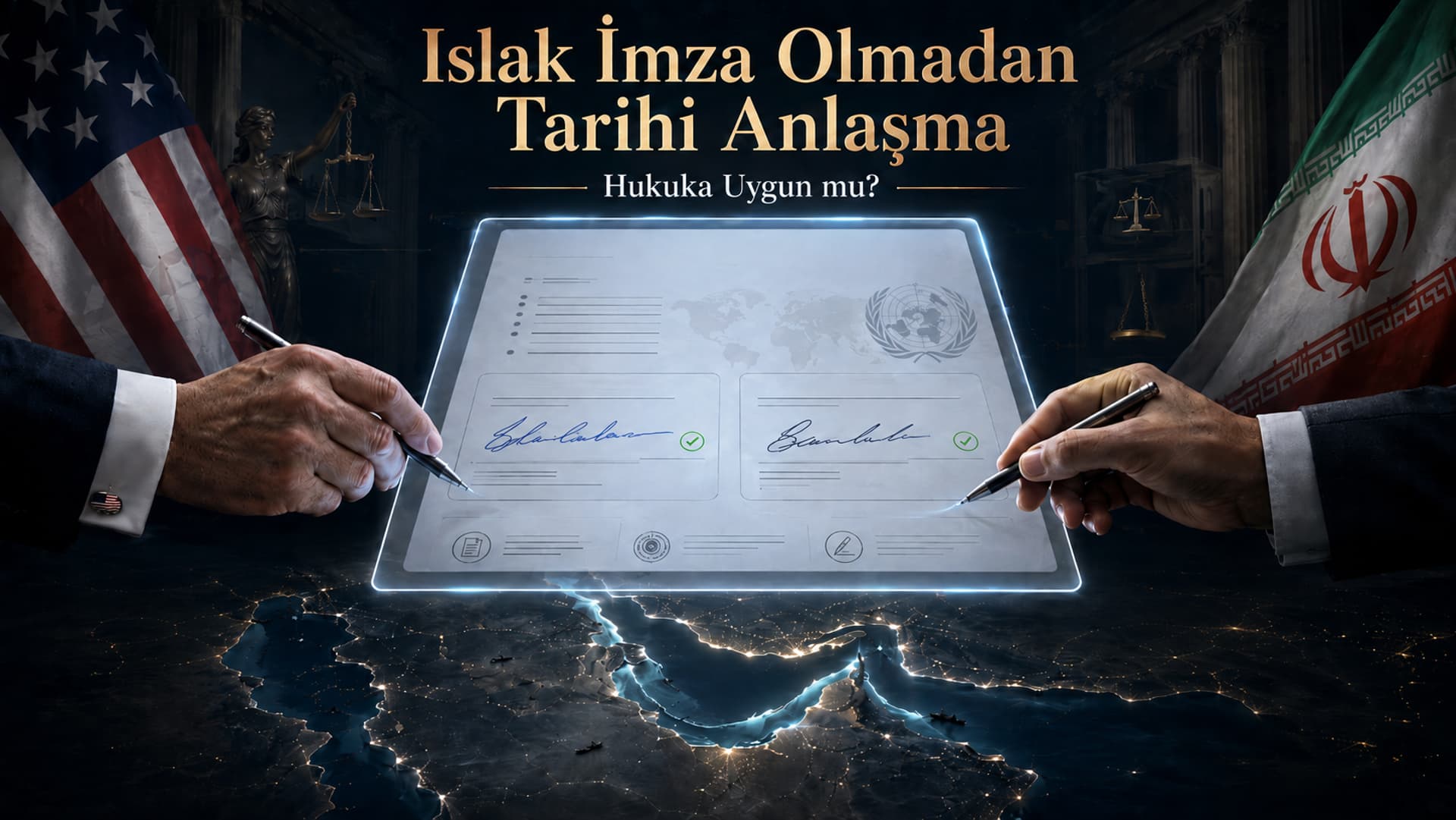
The new memorandum of understanding between the United States of America and Iran, concluded over the internet and brought into force by e-signature, has created a highly unusual situation in the world of international law. The text of the agreement contains very serious military and legal decisions, such as the immediate opening of the Strait of Hormuz to shipping traffic and the lifting of the naval blockade. The fact that this online step was taken without waiting for the official, physical signing ceremony planned for 19 June, in order to prevent the global crisis from deepening, has made the process even more remarkable. The information shared by world-renowned news sources such as the BBC, Reuters and The Guardian clearly shows how this agreement was signed and why it is so heavily debated in legal terms.
Under international law, states need neither hold signing ceremonies nor use ornate paper for an agreement to be regarded as valid; that is, the principle of freedom of form applies. According to Article 2 of the Vienna Convention on the Law of Treaties (VCLT), a treaty covers every kind of understanding concluded in writing between states and governed by international law, whether physical or digital. Accordingly, as long as the states agree, the signing of a document by e-signature on a computer does not in itself render it invalid. Global news sources also confirm that this short text of approximately one and a half pages was signed entirely in the digital environment. However, signing over the internet makes it difficult to determine at exactly which second, and according to the time of which country, the agreement entered into force. For this reason, computer and server records need to be kept very strictly. Moreover, the risk of a cyber-attack or fraud in digital signatures may in future lead states to seek to annul the agreement by taking refuge in the rules on “Error” in Article 48 or “Fraud” in Article 49 of the VCLT and claiming that the signature was not their own.
The most distinctive aspect of the agreement from a legal standpoint concerns the positions within the state held by the persons who signed it and their powers of representation under international law. Under Article 7 of the Vienna Convention on the Law of Treaties, the persons who may sign directly on behalf of a state without obtaining prior authorisation or a “Full Powers” instrument are very limited. These persons are only Heads of State, Heads of Government and Ministers for Foreign Affairs. On the American side, the signature of President Donald Trump is entirely consistent with this rule and binds the state directly. The co-signature of Vice President JD Vance, on the other hand, relates to the balance of power under American domestic law. In US law, such instruments, which are not submitted for Congressional approval and are concluded solely under the authority of the President, are called executive agreements. The use of a double signature by Trump and Vance is a diplomatic procedure chosen both to show the world the resolve of the American government internally and to guarantee that this digital commitment will be honoured even if the administration changes in the future.
On the Iranian side, however, the fact that the signature was affixed not by a member of the executive or of the government but by Mohammad Bagher Ghalibaf, the head of parliament, is, under international law, a clear case of acting beyond authority (ultra vires). This is because “Speakers of Parliament” are not among the authorised persons listed in Article 7 of the Vienna Convention. Therefore, in order for Ghalibaf to be able to affix this signature, he must hold a special instrument of authority. Moreover, this situation is also entirely contrary to Iranian domestic law and the Iranian Constitution. Under Article 110 of the Iranian Constitution, the authority to have the final say in foreign policy on war, peace and strategic steps belongs solely to the Supreme Leader. In addition, Article 77 of the Constitution makes it mandatory that all international agreements concluded with other countries pass through parliamentary approval. For the Speaker of Parliament, who should normally supervise and approve agreements, to go in person and sign as if he were the executing party may legally give rise to a situation of “absolute nullity”, that is, complete invalidity from the outset.
So, does this irregularity in Iranian domestic law render the agreement invalid at the international level? It is at this point that Article 46 of the Vienna Convention on the Law of Treaties comes into play. Under this rule, a state cannot easily escape its word by saying “this agreement was contrary to our domestic laws and our constitution”. For a violation of domestic law to invalidate an agreement, the violation must both concern a rule of fundamental importance and be objectively evident to the other party. A major state such as America must be aware that the speaker of a parliament cannot, alone, bind the state; that is, the violation is in fact manifest. However, the statement by Iranian President Pezeshkian, speaking to the foreign press, that he fully supports the agreement, and the confirmation by the global media that Supreme Leader Khamenei has given the green light to the matter, change the legal balance. Since Iran’s highest-level leaders have approved this digital process, the principle of the prohibition of contradictory conduct in international law comes into play. That is, since the Iranian state apparatus has declared to the world that it stands behind this signature, it cannot unilaterally cancel the agreement by saying “our Speaker of Parliament had no authority” when circumstances change.
Another noteworthy point in the matter of digital signatures is the platform used. According to information reported to the public, the signatures were affixed via a private electronic signature platform called DocuSign. This should not be regarded merely as a technical choice; it should also be assessed in terms of its legal consequences. Third-party platforms such as DocuSign create a detailed audit trail for each signing transaction: who signed, from which IP address, in which time zone and with which device is recorded. These records will serve as a strong means of proof against the defences of “error” and “fraud” under Articles 48 and 49 of the VCLT in any disputes that may arise in the future. On the other hand, this choice also brings new legal questions: Is it acceptable for an extremely critical document concerning state sovereignty to be entrusted to the servers of a private company outside the states’ own control? How will the authenticity of the document be proved if that company goes bankrupt, its servers are seized or it suffers a cyber-attack? These questions, which have not yet been sufficiently discussed in the international law literature, point to a significant gap in terms of digital sovereignty and document security.
The matter of the legal “moment” of a digital signature has also emerged particularly clearly in this agreement. Traditional physical ceremonies ensure that the parties sign at the same table and simultaneously; the moment at which the agreement enters into force is therefore beyond dispute. In this agreement, however, the signatures were affixed in different geographies, in different time zones and at successive intervals. On examining the information reported in the press, it appears that the signatures were completed just after midnight on 14 June 2026; however, this development could only be announced to the public on 15 June. That is, there was a delay even between the moment at which the signature was affixed and the moment at which it was announced. This brings to light a problem that has not previously been encountered so markedly in international law: In a document that several signatories have signed digitally at different times, which is the “moment” at which the agreement legally enters into force? The answer to this question is of great importance in terms of legal consequences.
The fundamental criterion determining the answer to this question is the text of the agreement itself. According to the general principle known in international law as the “last signatory rule”, in a multilateral document the moment of entry into force is the moment at which the last signature is affixed, since legal bindingness arises only once the will of all parties has been united. In the memorandum of understanding in question, however, the order in which the signatures were completed and their exact time have not yet been shared with the public. Nevertheless, what is decisive is the date contained in the text itself. If a specific date is written in the text of the agreement, then even if the signatures were completed after that date, the date borne by the text will be taken as the date of validity of the agreement, since the parties’ common intention was shaped at that date towards putting the agreement into effect. Indeed, this principle also applies in domestic law: even if the date written on a contract and the date of signing differ, where the parties have clearly demonstrated their intention to be bound at that date, the date of the contract is taken as decisive. Accordingly, as regards this agreement too, the date appearing in the text of the document will be accepted as the date of legal entry into force; the fact that the signatures were completed one after another and at different moments will not change this result.
The reason behind the choice of digital signature is also worth assessing from a legal perspective. According to information reported to the public, the plan to sign the agreement in the digital environment was put into effect within the last twenty-four hours in order to prevent last-minute snags and to secure the agreement as soon as possible. Initially, a face-to-face signing ceremony had been planned for 19 June in Switzerland; however, under the pressure created by the crisis environment, the digital method was preferred. This is an important precedent for the practice of international law: diplomatic urgency has led the parties towards a new legal method that has not yet fully settled. Even if the method itself is legally valid—as explained above, it is valid within the framework of the principle of freedom of form under the VCLT—the question whether this choice stemmed from necessity or from a strategic calculation may give rise to differing interpretations between the parties in the course of future negotiations.
At this point, the legal function of the official ceremony planned to take place in Switzerland on 19 June must also be separately questioned. If the agreement has already entered into force on 14 June by way of the digital signatures, what will be the legal value of the 19 June ceremony? The answer to this question is meaningful not in terms of the validity of the agreement, but only in terms of its implementation and ease of proof. In legal terms, the 19 June ceremony does not have the nature of “ratification” or “approval”, since the agreement is already in force. The ceremony serves as a diplomatic confirmation and as a public registration; furthermore, under Article 81 of the VCLT, it lays the ground for initiating the process of registering the agreement with the United Nations Secretariat. On the other hand, it should not be overlooked that the ceremony may be used strategically by Iran to effectively remedy the authority problem, discussed above, relating to Ghalibaf’s signature: the attendance of the competent Iranian authorities at the ceremony and their express approval of the agreement would legally close the authority problem, both under the mechanism of subsequent approval under VCLT Article 8 and under the principle of the prohibition of contradictory conduct.
In conclusion, although this document has been given the name of a light “Memorandum of Understanding” (MoU) with little legal bindingness, the fact that it produces military and economic consequences as significant as opening the Strait of Hormuz makes it, legally, a full international agreement. This is because international courts and the rules of the Vienna Convention look not at the name written at the top of the document but at how serious the legal obligations imposed on the states by the provisions within it are. Even though these signatures, affixed over the internet to speed things up in moments of crisis, appear to have somewhat strained, or even breached, the domestic legal rules and constitutional limits of both countries, thanks to the consent of the states’ leaders to the process and their standing behind it, the document has been transformed into a very strong and valid instrument of international law that currently operates smoothly in practice and resolves the crisis.